


2025 IAPOP Gathering About Worldwork
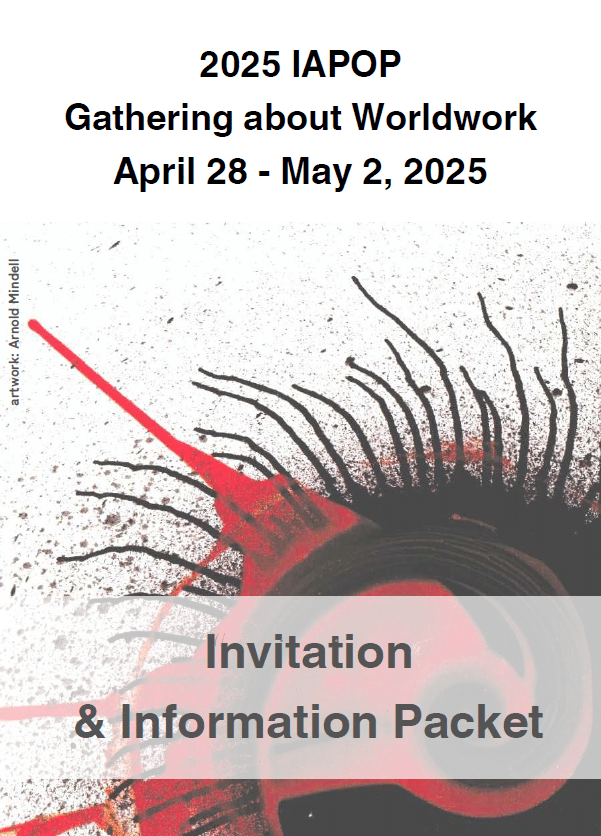
28 April – 2 May 2025
Loutraki, Greece
This international gathering of Processwork professionals was organized by the International Association of Process Oriented Psychology exclusively for its members, with the aim of studying feedback collected from practitioners applying the Worldwork methodology in the facilitation of conflicts and tensions within groups, organizations, and communities. The meeting created a collective space for exploring the challenges that emerge through issues of diversity, power dynamics, communication, and systemic discrimination, while also contributing to the co-evolution of the Worldwork methodology itself. Particular emphasis was placed on the ways these dynamics unfold within multicultural and intersectional contexts.
A total of 82 professionals from 21 countries participated in the gathering, including 52 in-person and 30 online participants. The structure of the meeting drew on methodologies such as Worldwork, Action Research, Open Space Technology, the World Café, and the Go Deep Game, combining experiential, participatory, and reflective processes.
The first day focused on building connection among participants, shaping the agenda, and forming facilitation teams. The following days concentrated on action research, experimentation with facilitation methods, and methodological innovation, while the final day focused on integrating insights and envisioning future directions for Worldwork.
The in-person program included large group meetings using Group Process, reflective sessions exploring facilitation and process dynamics, small group explorations using Open Space and World Café methodologies, daily plenary exchanges between online and in-person participants, and evening experiential presentations. At the same time, online groups worked in parallel on methodological reflections, explored tensions and conflicts emerging within the international Processwork community, and examined their own interactions through the lens of action research.
Key themes that emerged included power dynamics, experiences of discrimination (racism, sexism, classism, ableism), tensions between activism-oriented facilitation and process-oriented facilitation, competition among facilitators, and the need to integrate trauma-informed approaches into conflict facilitation practices.
Participants observed that naming and framing power dynamics, recognizing contextual power, and creating space for voices that often struggle to be heard transformed the group atmosphere and strengthened the sense of safety and connection. At the same time, the exploration of the perceived polarity between activism-oriented facilitation and process-following facilitation revealed them to be complementary rather than opposing forces.
Special emphasis was placed on integrating trauma-informed practices into Group Process through active listening, embodied presence, respect for personal stories, and the cultivation of safety and consent. The gathering also highlighted the importance of integrating bodywork and movement into conflict facilitation, being transparent about the emotional intensity that group processes may evoke, and developing awareness around unconscious uses of power.
Overall, the gathering offered a living example of an international community courageously applying its own principles to itself, linking the philosophy of Processwork with social justice awareness, collective consciousness, compassion, and an evolving facilitation practice.
The Board of IAPOP expressed its gratitude to ΕΠΕΑΣ in Greece for co-organizing and supporting the event, as well as to Lili Vassiliou and all members of the Organizing Committee — Lena Aslanidou, Venetia Bouronikou, Standa Hasa, Barbara Leuner, Conchi Piñero, Daya (Mia Tadeka), and Gregory Vellios — for their contribution and work.
The event brochure is available here .